
The humanities are the study of how people process and document the human experience. They encourage critical thinking, analytical reasoning, and a deeper understanding of culture, history, and ethics. This guide is designed to highlight the breadth of this academic field and its lasting relevance.
A Comprehensive Guide to Humanities Courses
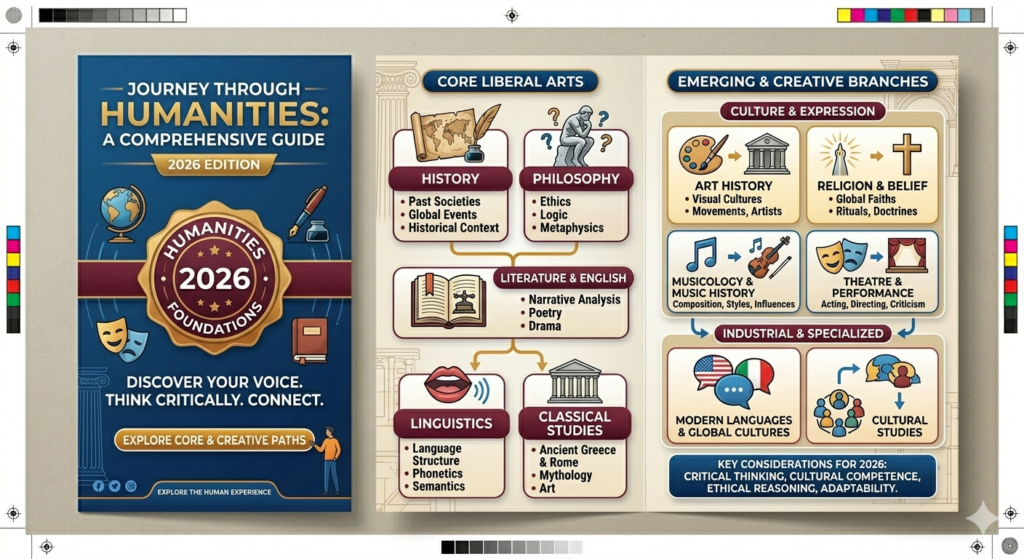
Here is a detailed list of the essential humanities disciplines, as structured in the accompanying visual guide:
Section 1: Core Liberal Arts
These are the foundational disciplines that examine the core of human thought, expression, and historical context.
History: The comprehensive study of past events, societies, and civilizations. Courses analyze how the past has shaped the present.
Philosophy: Exploring fundamental questions about existence, ethics, knowledge, and reason. It emphasizes critical thought and moral reasoning.
Literature & English: The study of written works (fiction, poetry, drama) from various eras and cultures. Focuses on textual analysis, interpretation, and writing skills.
Linguistics: The scientific study of language structure, its evolution, acquisition, and role in human communication.
Classical Studies: Exploring the history, literature, languages, and cultures of ancient civilizations, primarily Greece and Rome.
Section 2: Culture & Expression
This group examines how different communities express their identity and the impact of these expressions on the world.
Art History: Analyzing visual arts across cultures and eras to understand their historical significance and the context in which they were created.
Cultural Studies: An interdisciplinary field that examines how culture constructs social reality and political power.
Musicology & Music History: The academic study of music, exploring its theory, historical development, and cultural impact.
Theatre & Performance Studies: Investigating the performing arts (acting, directing, design) as tools for storytelling and social commentary.
Modern Languages: The study of contemporary languages and their associated cultures, fostering cross-cultural competence.
Section 3: Thought & Belief
These courses focus on the systems of belief and communication that define human interaction and societal norms.
Religions & Theology: The comparative study of global religious beliefs, texts, rituals, and their influence on history and contemporary life.
Communication Studies: Examining how information is conveyed and received (media, rhetoric, intercultural communication), shaping public opinion.
Ethics & Moral Philosophy: Concentrating on defining and defending concepts of right and wrong, guiding personal conduct and public policy.
World Religions: Deep-diving into the distinct doctrines and practices of major faith traditions.
Intercultural Communication: Analyzing the dynamics of communication between people from diverse cultural backgrounds.