
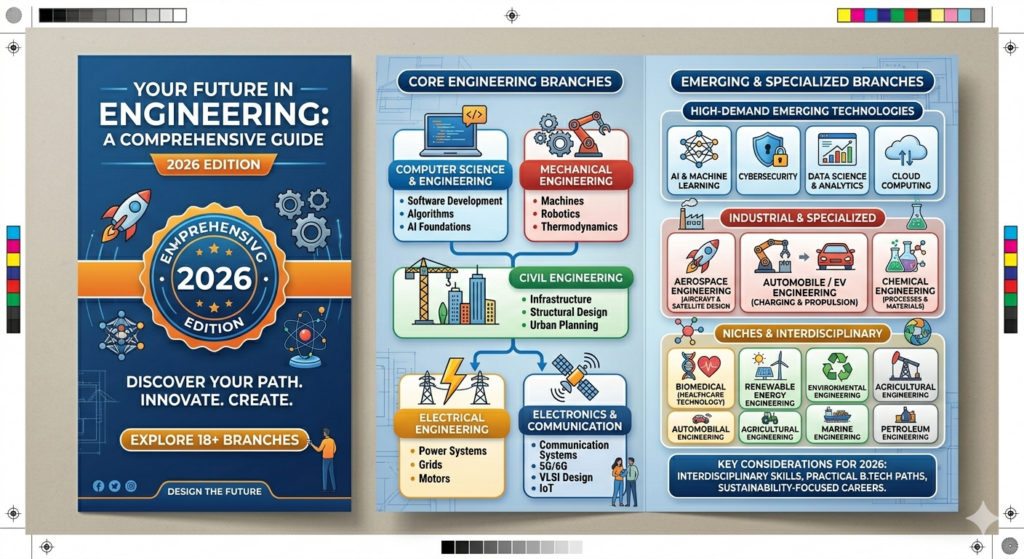
Engineering has evolved significantly, branching out from traditional fields into highly specialized “new-age” disciplines. Here is a comprehensive list of engineering courses categorized by their domain and future relevance as of 2026.
1. The “Big Five” (Core Branches)
These are the foundational pillars of engineering. Most other specialized courses are offshoots of these five.
Computer Science & Engineering (CSE): Focuses on software development, algorithms, and computing systems.
Mechanical Engineering: The study of machines, manufacturing, thermodynamics, and robotics.
Civil Engineering: Covers infrastructure, structural design, transportation, and urban planning.
Electrical Engineering: Focuses on power systems, electrical grids, and motors.
Electronics & Communication Engineering (ECE): Bridges the gap between hardware and communication systems (5G, VLSI, and IoT).
2. High-Demand Emerging Technologies
In 2026, these fields are seeing the fastest job growth and highest entry-level salaries.
| Course Name | Key Focus Areas |
| AI & Machine Learning | Neural networks, Generative AI, and automation. |
| Cybersecurity Engineering | Ethical hacking, network security, and cryptography. |
| Data Science & Engineering | Big data analytics, statistical modeling, and BI. |
| Robotics & Automation | Mechatronics, industrial cobots, and autonomous systems. |
| Cloud Computing | AWS/Azure/GCP infrastructure and DevOps pipelines. |
| Blockchain Engineering | Decentralized apps (dApps) and secure digital identities. |
3. Specialized & Industry-Specific Branches
These courses are tailored for specific sectors like aviation, medicine, or energy.
Aerospace Engineering: Design of aircraft, satellites, and drones.
Biomedical Engineering: Merging biology with electronics for medical devices and prosthetics.
Renewable Energy Engineering: Focused on solar, wind, hydrogen, and battery storage tech.
Chemical Engineering: Refining processes, pharmaceuticals, and materials science.
Automobile/EV Engineering: Traditional vehicle design shifting toward Electric Vehicle (EV) tech.
Environmental Engineering: Waste management, sustainability, and climate change solutions.
4. Niche & Interdisciplinary Courses
For those looking for highly specific career paths:
Nanotechnology Engineering: Working with materials at the atomic or molecular scale.
Petroleum Engineering: Extraction and production of oil and gas.
Agricultural Engineering: Improving farming efficiency through machinery and irrigation.
Marine Engineering: Design and maintenance of seagoing vessels and offshore structures.
Textile Engineering: Development of polymers and fiber-based products.
Key Considerations for 2026
Practicality: Many universities now offer B.Tech (Bachelor of Technology), which is more practice-oriented, while B.E. (Bachelor of Engineering) remains more theoretical.
Interdisciplinary Skills: The most successful engineers today are those who blend fields—for example, a Civil Engineer who understands Data Science to build “Smart Cities.”
Which of these domains aligns most with your current interests or career goals?