
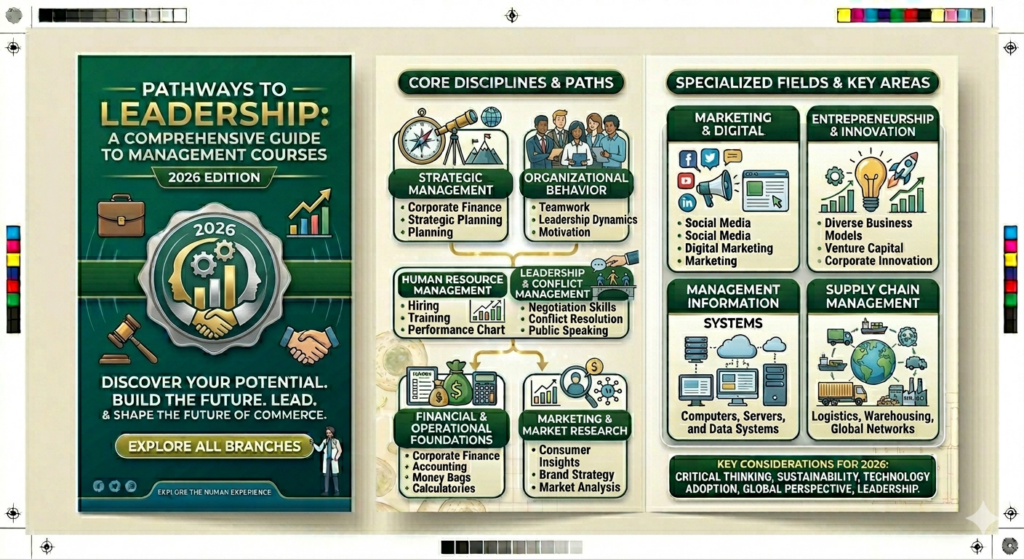
A management education is crucial for translating vision into action, fostering innovation, and steering complex organizations toward success in the modern, digital economy.
Part 1: Comprehensive List of Management Courses (2026 Curriculum)
The modern management curriculum is structured to blend foundational theory with specialized, practical skills. Here is a list of essential courses categorized by their core domains.
I. Core Leadership & Vision
These courses focus on high-level decision-making and the internal dynamics of people and structure.
Organizational Behavior (OB): The science of how individuals, teams, and structures behave within a company.
Strategic Management: Crafting long-term vision, analyzing competitive landscapes, and executing business plans.
Human Resource Management (HRM): Focuses on recruitment, talent development, and building a cohesive, productive workforce.
Leadership & Conflict Resolution: Developing the emotional intelligence and skills to lead teams through challenge and change.
Change Management: Strategies for guiding an organization through significant structural or cultural transitions.
II. Quantitative & Financial Foundations
The mathematical tools required for measurable decision-making and performance evaluation.
Accounting & Financial Management: The language of business: tracking profitability, budgeting, and managing assets.
Managerial Economics: Applying microeconomic analysis to business decisions, pricing, and resource allocation.
Operations & Supply Chain Management: Optimizing the production process and the flow of goods from source to consumer.
Business Statistics: The use of mathematical models and data to analyze performance and forecast trends.
Quantitative Methods for Managers: Advanced math applied to problem-solving and optimization.
III. Modern Business Functions & Specializations
These areas apply core principles to specific, high-demand operational sectors.
Marketing Management: Strategies for understanding customers, building brands, and generating demand.
Management Information Systems (MIS): Leveraging technology and software to manage business processes and data.
Digital Marketing & Analytics: Focused on using online channels and data analysis for targeted customer acquisition.
Corporate Finance & Investment: Focuses on raising capital, valuing investments, and managing financial risk.
Entrepreneurship & Innovation: Developing the mindset and tools to launch new ventures and lead corporate innovation.
IV. Ethics, Global Context & Special Areas
Critical thinking courses that prepare managers for external responsibilities and niche sectors.
Business Ethics & Corporate Social Responsibility (CSR): Leading with integrity and managing an organization’s impact on society.
Global Business Management: Navigating cultural differences, international regulations, and global trade.
Healthcare Management: Applying business principles to the complex, regulated healthcare industry.
Hospitality & Tourism Management: Leading organizations in the leisure, travel, and events sectors.
Sustainable Business & Green Management: Focuses on building profitable, eco-friendly business models for the future.